Tuesday, February 17, 2009


Sebuah jembatan alam misterius yang dinamakan jembatan Rama (disebut juga Jembatan Adam), membentang sepanjang 30 km diselat Palk yang memisahkan India dan Srilanka. Lengkungan jembatan yang unik dan komposisi alamiahnya seakan-akan buatan tangan manusia.

Berdasarkan penelitian legenda arkeologi menyebutkan bahwa usia jembatan ini 1,7 juta tahun yang lalu. Namun menurut hasil penelitian dari Universitas Bharathidasan, Tiruchi, yang dipimpin oleh Prof. S.M. Ramasamy mengatakan usia jembatan Rama ini baru berusia 3.500 tahun yang lalu.

Namun begitu beberapa kelompok penganut agama Hindu, mengklaim jembatan ini berkaitan dengan epik Ramayana dan foto-foto dari NASA ini semakin memperkuat keyakinan mereka.

Dalam cerita Ramayana, mengisahkan jembatan ini dibangun atas permintaan Rama untuk menyelamatkan istrinya yang diculik oleh Rahwana.

Jembatan ini dibangun dengan menggunakan batu dan pasir apung, namun para Dewa mengatakan dikemudian hari batuan tersebut akan menancap ke dasar laut, yang akhirnya menciptakan rangkaian batu karang. (EpochTimes)

Saturday, December 6, 2008

Should be one of 7 Wonder..

BAMIYAN, Afghanistan -- French archeologists searching for the colossal Sleeping Buddha in Bamiyan province have uncovered what could be the long-missing statue's foot, raising hopes of a major new discovery from Afghanistan's ancient Buddhist past.


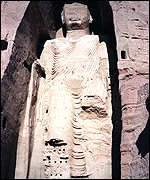
Ever since the fundamentalist Taliban destroyed Bamiyan's 1,500-year-old Standing Buddhas in 2001 because they were "un-Islamic," attention has been focused on the hunt for the much larger Sleeping Buddha, described in the travel diary of the seventh-century Chinese monk Xuan Zang and depicted in cave paintings at the historic site in the Hindu Kush mountains west of Kabul.


Two years ago, a French team led by the Afghan-born archeologist Zemaryali Tarzi of Strasbourg University began excavations for the 985-foot-long reclining statue representing the Buddha in a state of "Mahapari nirvana," or ultimate enlightenment.


The dig finally may have yielded something promising.

"Professor Tarzi has found a structure which has still to be properly identified but which could be part of the foot of the Sleeping Buddha, maybe the toe," said Masanori Nagaoka, UNESCO's Kabul-based culture consultant.

"Alternatively, the structure could be the platform on which the giant statue reclined," he added.

The discovery just east of the site of the razed Buddhas has generated considerable excitement among the foreign experts working in the Bamiyan Valley.

"Along with this intriguing find, Professor Tarzi has excavated 11 fragments from smaller sculptures, including half-a-dozen heads and a torso," said Edmund Melzl, a German restorer with the International Council on Monuments and Sites.

"The torso still has some color on it," Mr. Melzl added. This is considered highly significant, because so few artifacts survive from Bamiyan's Buddhist past.

While the French have been digging, German specialists have been cataloguing and conserving the brittle debris from the destroyed 180-foot and 125-foot Standing Buddhas.

An Italian group is in charge of reinforcing the two empty niches where the imposing stone statues stood, while Japanese experts are restoring and preserving the surviving mural paintings in a few of the 1,000-plus caves along Bamiyan's magnificent, camel-colored cliffs.

The Japanese have also used state-of-the-art laser technology to survey the entire area, which could help uncover other buried Buddhist artifacts and sites. The results of the survey will be known next month.

The German, Italian and Japanese missions are funded by UNESCO, while the French archeologists are supported by their government and National Geographic magazine. With snow enveloping Bamiyan last week, all the missions have packed up for winter and will return next year.

"Until now, UNESCO has not focused on archaeological excavation, since for the first two years we had less than $2 million for the Bamiyan project," Mr. Nagaoka said.

He said UNESCO's Bamiyan Working Group is to meet in Tokyo Dec. 18-21 to plan the second phase of exploration at the historic Buddhist site. Mr. Tarzi has also been invited.

UNESCO has been under considerable pressure to help with the reconstruction of the Standing Buddhas. The people of Bamiyan province, Shi'ite Hazaras who suffered terribly under Taliban rule, want to see the statues rebuilt.

However, the rebuilding issue is generating controversy.

First, the statues cannot be made from the original material, because the rock face from which they were carved disappeared in the Taliban's dynamite-and-artillery vandalism.

The project could cost around $50 million, which some regard as a criminal waste of money in the country's destitute central highlands.

"There's also the question of which Buddhas to rebuild," said Mr. Nagaoka: "As the statues were in the seventh century [when they were partly covered with brass], or as they were just before the Taliban destroyed them?"

Mr. Tarzi has suggested that instead of rebuilding the Buddhas at great cost, a hologram of the statues should be projected into the niches. But if his mission to find the third colossal Buddha is successful, then Bamiyan could once again become a major destination for pilgrims and tourists.

The scale of the Sleeping Buddha, probably built in the second half of the sixth century when Bamiyan province was a major commercial and pilgrim center, is mind-boggling.

It would have been the length of three soccer fields, or the same size as the Eiffel Tower placed horizontally, with the Buddha's shoulder rising more than 80 feet.

For this reason experts believe the Sleeping Buddha was probably made of mud bricks rather than stone, and would have been highly susceptible to erosion and damage from nature and man.

The destruction would have accelerated after Buddhism faded from the Bamiyan Valley and was replaced by iconoclastic Islam.

"Following the Muslim invasion in A.D. 977, many of the bricks from the Sleeping Buddha could well have been used for building houses," Mr. Melzl said.

But Mr. Tarzi's discovery may finally help resolve the mystery of the missing Buddha.

By Maseeh Rahman, THE WASHINGTON TIMES, December 5, 2004

Buddhist Chanel

Wednesday, August 27, 2008

The 4 Noble Truth

1. Life means suffering.

2. The origin of suffering is attachment.

3. The cessation of suffering is attainable.

4. The path to the cessation of suffering.

1. Life means suffering.

To live means to suffer, because the human nature is not perfect and neither is the world we live in. During our lifetime, we inevitably have to endure physical suffering such as pain, sickness, injury, tiredness, old age, and eventually death; and we have to endure psychological suffering like sadness, fear, frustration, disappointment, and depression. Although there are different degrees of suffering and there are also positive experiences in life that we perceive as the opposite of suffering, such as ease, comfort and happiness, life in its totality is imperfect and incomplete, because our world is subject to impermanence. This means we are never able to keep permanently what we strive for, and just as happy moments pass by, we ourselves and our loved ones will pass away one day, too.

2. The origin of suffering is attachment.

The origin of suffering is attachment to transient things and the ignorance thereof. Transient things do not only include the physical objects that surround us, but also ideas, and -in a greater sense- all objects of our perception. Ignorance is the lack of understanding of how our mind is attached to impermanent things. The reasons for suffering are desire, passion, ardour, pursuit of wealth and prestige, striving for fame and popularity, or in short: craving and clinging. Because the objects of our attachment are transient, their loss is inevitable, thus suffering will necessarily follow. Objects of attachment also include the idea of a "self" which is a delusion, because there is no abiding self. What we call "self" is just an imagined entity, and we are merely a part of the ceaseless becoming of the universe.

3. The cessation of suffering is attainable.

The cessation of suffering can be attained through nirodha. Nirodha means the unmaking of sensual craving and conceptual attachment. The third noble truth expresses the idea that suffering can be ended by attaining dispassion. Nirodha extinguishes all forms of clinging and attachment. This means that suffering can be overcome through human activity, simply by removing the cause of suffering. Attaining and perfecting dispassion is a process of many levels that ultimately results in the state of Nirvana. Nirvana means freedom from all worries, troubles, complexes, fabrications and ideas. Nirvana is not comprehensible for those who have not attained it.

4. The path to the cessation of suffering.

There is a path to the end of suffering - a gradual path of self-improvement, which is described more detailed in the Eightfold Path. It is the middle way between the two extremes of excessive self-indulgence (hedonism) and excessive self-mortification (asceticism); and it leads to the end of the cycle of rebirth. The latter quality discerns it from other paths which are merely "wandering on the wheel of becoming", because these do not have a final object. The path to the end of suffering can extend over many lifetimes, throughout which every individual rebirth is subject to karmic conditioning. Craving, ignorance, delusions, and its effects will disappear gradually, as progress is made on the path.


source : http://www.thebigview.com/buddhism/fourtruths.html